 In the latest installment of Dear Economist, Tim Harford sheds some light about the economics of wine. My conclusion, we're really paying for the name, not the taste.
Friday, November 17, 2006
Paying for the Name
In the latest installment of Dear Economist, Tim Harford sheds some light about the economics of wine. My conclusion, we're really paying for the name, not the taste.


Thursday, November 16, 2006
Formula 1 Technology and its Application
I brought up the topic so much in yesterday's post that it seems only fitting that the FIA and the GPMA (Grand Prix Manufacturers Association) talk about the future of technology in Formula 1, their real world applications, and how the rules might be crafted for that future.
It's a horrifically long read for anyone who was hoping for something short. However, Max Mosley and Burkhard Goschel make many interesting points, and they're in the beginning. Here's that link again.
It's a horrifically long read for anyone who was hoping for something short. However, Max Mosley and Burkhard Goschel make many interesting points, and they're in the beginning. Here's that link again.
Wednesday, November 15, 2006
The Real Question in Motor Sports
Well, Kevin Tressler has replied to discuss some of the similarities, and the more important differences in modern motor sports.
Kevin rightly states that the
However, with respect to your first similarity, the difference here between NASCAR and the NHRA versus many open wheel series (e.g. Formula 1, Champ Car etc.) is that the applications of the technology is so different. That is to say that Ford, Chevrolet, Dodge, and Pontiac have almost nothing to do with technology that’s being put into those cars.
Whereas Toyota F1, BMW Sauber F1, etc. all are actual subsidiaries of their manufacturer parents. Toyota actually uses a Toyota power plant in its Formula 1 operation, and they routinely have conferences with the engineers in Japan who design and work on the engines many people drive daily. In the Mazda Star series (a minor league of American open wheel racing), they actually use the rotary engines that are found in the Mazda RX-8.
Compare that actual use of technology with the complete disconnect of the operations that are done in NASCAR and the NHRA. Do you think that John Force or Dale Earnhardt’s engines have anything to do with Ford or Chevrolet?
In your first point of similarity, you get the motive of wanting to go fast right, but each motor sport does it quite differently, and it’s the lack of actual manufacturer input that makes the NHRA and NASCAR that much more disingenuous.
You’re right again with your second similarity. As with any business, it’s about turning a profit and proliferating the brand. However, as I just stated, the NHRA and NASCAR do so disingenuously. The motto in the 60s and 70s was to win on Sunday and sell on Monday. But in today’s world, there is no reason for me to believe the Ford in the showroom has anything to do with the vehicle that competed in the race.
In contrast, look at the Speed Touring Car Challenge, or better yet the WRC. Not only are the manufacturers directly involved (like Formula 1), but these are actual cars that someone can purchase. Even in the WRC, they contain a “Group N” category that constrains anyone from making any modifications to the cars other than tires and safety equipment.
In terms of entertainment, this is how businesses in motor sport turn the profit. But let me tell you that there’s a reason why the rest of the world refers to NASCAR as “tin-top”, “taxi”, “fish bowl” racing. As much as American’s can’t understand road-course racing, the feeling is mutual from the rest of the world towards NASCAR. The venues are made for spectacular crashes. As I posted quite some time ago, its entertainment value is driven by the same arguments that preside themselves on Judge Judy.
But this is where the NHRA is far superior over the field; complete interaction with the drivers at events is unbeatable. Although, I would say that the other major series have reasons to protect their drivers from what would be a mob of fans or ill-wishers.
To your differences. The differences in format cannot be debated. In terms of performance, the numbers do speak for themselves, but I ask you about the real-world applications. And as I have posted in the past:
The WRC cars continue to develop better all wheel drive technology and better chassis developments. Formula 1 has greatly improved our valve spring technology, let alone the advances in the union of computers to our vehicles.
Kevin says:
Isn’t the disparity in each region’s use of technology a cultural difference?
I’ve written about women in motor sports before. And there is no argument from me on your take on women in motor sports. The NHRA has far and away been the more equal playing ground for women.
As I wrote above, you’re also right about the marketing of the drivers in the NHRA. They’re much more available to the fans.
In terms of the actual person that the NHRA attracts as a fan, the statistics don’t lie, and I only wish I could find the numbers for Formula 1 in America. And this is where I’ve been trying to lead to all along. What makes the entire world love Formula 1? And conversely, what makes America hate it so? My own thoughts on that question lend towards realizing that the US has always had always shown disdain towards many sports adored by the rest of the world (soccer, tennis, and hockey). But why? What makes Americans so different?
Kevin rightly states that the
…primal drive of any motorsport involves harnessing as much of man's modern automotive technology as possible to propel a car of some sort to speeds that would boggle the mind...
However, with respect to your first similarity, the difference here between NASCAR and the NHRA versus many open wheel series (e.g. Formula 1, Champ Car etc.) is that the applications of the technology is so different. That is to say that Ford, Chevrolet, Dodge, and Pontiac have almost nothing to do with technology that’s being put into those cars.
Whereas Toyota F1, BMW Sauber F1, etc. all are actual subsidiaries of their manufacturer parents. Toyota actually uses a Toyota power plant in its Formula 1 operation, and they routinely have conferences with the engineers in Japan who design and work on the engines many people drive daily. In the Mazda Star series (a minor league of American open wheel racing), they actually use the rotary engines that are found in the Mazda RX-8.
Compare that actual use of technology with the complete disconnect of the operations that are done in NASCAR and the NHRA. Do you think that John Force or Dale Earnhardt’s engines have anything to do with Ford or Chevrolet?
In your first point of similarity, you get the motive of wanting to go fast right, but each motor sport does it quite differently, and it’s the lack of actual manufacturer input that makes the NHRA and NASCAR that much more disingenuous.
You’re right again with your second similarity. As with any business, it’s about turning a profit and proliferating the brand. However, as I just stated, the NHRA and NASCAR do so disingenuously. The motto in the 60s and 70s was to win on Sunday and sell on Monday. But in today’s world, there is no reason for me to believe the Ford in the showroom has anything to do with the vehicle that competed in the race.
In contrast, look at the Speed Touring Car Challenge, or better yet the WRC. Not only are the manufacturers directly involved (like Formula 1), but these are actual cars that someone can purchase. Even in the WRC, they contain a “Group N” category that constrains anyone from making any modifications to the cars other than tires and safety equipment.
In terms of entertainment, this is how businesses in motor sport turn the profit. But let me tell you that there’s a reason why the rest of the world refers to NASCAR as “tin-top”, “taxi”, “fish bowl” racing. As much as American’s can’t understand road-course racing, the feeling is mutual from the rest of the world towards NASCAR. The venues are made for spectacular crashes. As I posted quite some time ago, its entertainment value is driven by the same arguments that preside themselves on Judge Judy.
But this is where the NHRA is far superior over the field; complete interaction with the drivers at events is unbeatable. Although, I would say that the other major series have reasons to protect their drivers from what would be a mob of fans or ill-wishers.
To your differences. The differences in format cannot be debated. In terms of performance, the numbers do speak for themselves, but I ask you about the real-world applications. And as I have posted in the past:
Essentially, it’s all about hot rods from the 50s and 60s. Meaning that, present day application is only applicable for people who like to work on their 50s and 60s hot rods.
The WRC cars continue to develop better all wheel drive technology and better chassis developments. Formula 1 has greatly improved our valve spring technology, let alone the advances in the union of computers to our vehicles.
Kevin says:
I assume you all to be intelligent human beings and you could easily research this on your own. I'm more interested in highlighting what I believe are the inherent cultural differences among the various motorsports.
Isn’t the disparity in each region’s use of technology a cultural difference?
I’ve written about women in motor sports before. And there is no argument from me on your take on women in motor sports. The NHRA has far and away been the more equal playing ground for women.
As I wrote above, you’re also right about the marketing of the drivers in the NHRA. They’re much more available to the fans.
In terms of the actual person that the NHRA attracts as a fan, the statistics don’t lie, and I only wish I could find the numbers for Formula 1 in America. And this is where I’ve been trying to lead to all along. What makes the entire world love Formula 1? And conversely, what makes America hate it so? My own thoughts on that question lend towards realizing that the US has always had always shown disdain towards many sports adored by the rest of the world (soccer, tennis, and hockey). But why? What makes Americans so different?
Cohen's Past
So, yesterday I used an article by Richard Cohen to illustrate that op-ed pieces in journalism allow a writer the liberty to speak on topics that might not be spoken upon so liberally by a staff writer.
Well, Glenn Greenwald today writes a post about Cohen and his pro-war op-ed history. However much Glenn uses Cohen as an example of how corrupt political dialogue can be (which he's right about, and Cohen did contribute to that), I think it gives that much more credence as to why Cohen's op-ed yesterday should be read. Cohen, who was so adamant about the war, now writes about how we were lied to. Just like Andrew Sullivan, people have the right to change their minds.
Well, Glenn Greenwald today writes a post about Cohen and his pro-war op-ed history. However much Glenn uses Cohen as an example of how corrupt political dialogue can be (which he's right about, and Cohen did contribute to that), I think it gives that much more credence as to why Cohen's op-ed yesterday should be read. Cohen, who was so adamant about the war, now writes about how we were lied to. Just like Andrew Sullivan, people have the right to change their minds.
Tuesday, November 14, 2006
The Power of op-ed
This is partly why op-ed writers are much better known to the public.
In the article linked above - which discusses the President’s blatant mistruth on the future of now former Secretary of Defense Donald Rumsfeld - Richard Cohen ends by writing:
For someone to try and belittle this statement and Cohen’s op-ed in whole, it would take a very sycophantic mindset in favor of President Bush. I say sycophantic because even the President’s excuses – as Cohen illustrates – don’t provide adequate reasoning. In terms of the lie about Rumsfeld, I think it would have been much better if he simply stuck to the reasoning of: I lied about Rumsfeld’s future to ensure that any change in his position would not be seen as a political/campaign ploy. But the president instead lied about the lie.
And the only “reporting” I’ve seen on this is from op-ed columnists. The president spoke a blatant mistruth about the now former Secretary of Defense who has been a key facilitator to the Iraq War, how is that not news?
One reporter I like to make note of is Charlie Savage, whose reports don’t towards opinion very often, is a reporter of note who doesn’t let everything go. As Dan Froomkin (see: “Signing Statement Watch”) many times has mentioned in the past, Savage is one of the few reporters who has continuously followed up on our president’s use of signing statements. He’s not an op-ed writer, yet in terms of the president’s use of signing statements, Savage has been quite thorough in his reporting.
There is one caveat in promoting op-ed writing, and that caveat is to admit the obvious fact that many of these writers are not objective, per se (although much of that is in the eye of the beholder), and as I had realized that, I was forced to understand that it was important to read op-eds from other writers with whom I did/do not agree.
Also, as you'll note from Greg Mankiw specifically, he most often has no problem picking out other economists or politicians with whom he does not agree, and discussing the relevant topic. That is truly part of what makes an author relevant and fun to read.
In the article linked above - which discusses the President’s blatant mistruth on the future of now former Secretary of Defense Donald Rumsfeld - Richard Cohen ends by writing:
This is not a matter of vengeance or, God forfend, politics, but of restoring the people's faith in their government. How dare these people lie to you and me and send Americans to die in Iraq for reasons that turned out to be wholly nonexistent? One way to return to the truth is to find the liars. I ask this not for myself but -- and I mean it -- for the troops.
For someone to try and belittle this statement and Cohen’s op-ed in whole, it would take a very sycophantic mindset in favor of President Bush. I say sycophantic because even the President’s excuses – as Cohen illustrates – don’t provide adequate reasoning. In terms of the lie about Rumsfeld, I think it would have been much better if he simply stuck to the reasoning of: I lied about Rumsfeld’s future to ensure that any change in his position would not be seen as a political/campaign ploy. But the president instead lied about the lie.
And the only “reporting” I’ve seen on this is from op-ed columnists. The president spoke a blatant mistruth about the now former Secretary of Defense who has been a key facilitator to the Iraq War, how is that not news?
One reporter I like to make note of is Charlie Savage, whose reports don’t towards opinion very often, is a reporter of note who doesn’t let everything go. As Dan Froomkin (see: “Signing Statement Watch”) many times has mentioned in the past, Savage is one of the few reporters who has continuously followed up on our president’s use of signing statements. He’s not an op-ed writer, yet in terms of the president’s use of signing statements, Savage has been quite thorough in his reporting.
There is one caveat in promoting op-ed writing, and that caveat is to admit the obvious fact that many of these writers are not objective, per se (although much of that is in the eye of the beholder), and as I had realized that, I was forced to understand that it was important to read op-eds from other writers with whom I did/do not agree.
Also, as you'll note from Greg Mankiw specifically, he most often has no problem picking out other economists or politicians with whom he does not agree, and discussing the relevant topic. That is truly part of what makes an author relevant and fun to read.
Monday, November 13, 2006
Similarities and Differences in Racing
For all the debate (that even I participate in) on the differences in motor sports, it is actually quite revealing to ponder on the similarities.
To engross the similarities in one term, I would call it the “bureaucracy.” What forms all types of motor sports in bureaucracy is that these organizations operate (as well they should) as businesses. These organizational structures allow for intricate back stories that provide the real motives to many of the decisions that are done in full knowledge and behind the scenes.
As my friend Kevin mentioned in spreading this rumor on the NHRA:
What’s important to note here is the back-story that actually exists for Allan Johnson and his crew chief aspirations in Funny Car. Johnson is nothing if not a legendary figure as a crew chief in the Top Fuel category. But his exploits in the Funny Car have been nothing of note, except for his mere participation. Three facts need to be known. First, crew chief Alan Johnson’s Funny Car deeds are rarely ever spoken of. Second, those Funny Car efforts have amounted into very little success. And third, they’ve all been for Toyota‘s effort to gain market share in this “I hate anything that’s not American” demographic. (By the way, did I mention that Toyota had its global master plan leaked)?
Alan Johnson and former active Funny Car driver, Jerry Toliver, have been key figures in trying to match Toyota to somebody’s Funny Car team.
This is no doubt (while possibly not as complicated) very similar to the stories that are played out all the time in Formula 1 with many car makers debating and talking to different teams in order to see if there is a viable chance that they can enter the Formula 1 series as engine manufacturers. Most recently, Nissan has been discussing its probabilities of entering Formula 1 and what it would take for success. Their talks have been facilitated by the fact that Nissan is in alliance with Renault (current manufacturer champion in Formula 1).
I want to ask Kevin, if he’s so smart: what are the real differences in various forms of motor sports? (Other than the fact that in drag racing you don’t turn; Formula 1 uses primarily road courses; and NASCAR uses oval racing). And I am more than willing to name some of the differences myself. So, Kevin, are you willing to participate in this discussion?
To engross the similarities in one term, I would call it the “bureaucracy.” What forms all types of motor sports in bureaucracy is that these organizations operate (as well they should) as businesses. These organizational structures allow for intricate back stories that provide the real motives to many of the decisions that are done in full knowledge and behind the scenes.
As my friend Kevin mentioned in spreading this rumor on the NHRA:
…everyone knows that the minute the awards banquet ends, the crazy rumors start to fly…And surely, there's no truth to the rumor that Alan Johnson is leaving DSR (MK: Don Schumacher Racing) to wrench on Scott Kalitta's Celica FC (MK: Funny Car) next year, right?
What’s important to note here is the back-story that actually exists for Allan Johnson and his crew chief aspirations in Funny Car. Johnson is nothing if not a legendary figure as a crew chief in the Top Fuel category. But his exploits in the Funny Car have been nothing of note, except for his mere participation. Three facts need to be known. First, crew chief Alan Johnson’s Funny Car deeds are rarely ever spoken of. Second, those Funny Car efforts have amounted into very little success. And third, they’ve all been for Toyota‘s effort to gain market share in this “I hate anything that’s not American” demographic. (By the way, did I mention that Toyota had its global master plan leaked)?
Alan Johnson and former active Funny Car driver, Jerry Toliver, have been key figures in trying to match Toyota to somebody’s Funny Car team.
This is no doubt (while possibly not as complicated) very similar to the stories that are played out all the time in Formula 1 with many car makers debating and talking to different teams in order to see if there is a viable chance that they can enter the Formula 1 series as engine manufacturers. Most recently, Nissan has been discussing its probabilities of entering Formula 1 and what it would take for success. Their talks have been facilitated by the fact that Nissan is in alliance with Renault (current manufacturer champion in Formula 1).
I want to ask Kevin, if he’s so smart: what are the real differences in various forms of motor sports? (Other than the fact that in drag racing you don’t turn; Formula 1 uses primarily road courses; and NASCAR uses oval racing). And I am more than willing to name some of the differences myself. So, Kevin, are you willing to participate in this discussion?
Tuesday, November 07, 2006
Myth of the Rational Voter
Well, other than the fact that today is Election Day, I’m writing this post about Bryan Caplan’s to be released book, Myth of the Rational Voter. Caplan provides a preview here.
Even Robert Samuelson has written about how we vote. Samuelson, Caplan and many other economists believe that if there are fewer voters, it is not necessarily a bad outcome. Once again, this may simply be roll off , which reflects that many potential voters don't vote because they are aware of their own lack of knowledge on many issues and/or candidates.
I recommend reading any one of the three links I’ve provided. They’ll make you think about researching to make a tough decision on who to vote for, or you’ll feel fine that by not voting you are making an honest choice as well.
Even Robert Samuelson has written about how we vote. Samuelson, Caplan and many other economists believe that if there are fewer voters, it is not necessarily a bad outcome. Once again, this may simply be roll off , which reflects that many potential voters don't vote because they are aware of their own lack of knowledge on many issues and/or candidates.
I recommend reading any one of the three links I’ve provided. They’ll make you think about researching to make a tough decision on who to vote for, or you’ll feel fine that by not voting you are making an honest choice as well.
Monday, November 06, 2006
Gravel Girls
This calendar is another great cause. It’s to help support the Wales Air Ambulance that many rally drivers and co-drivers depend on in Wales.
And about the gravel girls: I am glad to see so many women participating in rallying as I just wrote about the topic of women in racing earlier.
And about the gravel girls: I am glad to see so many women participating in rallying as I just wrote about the topic of women in racing earlier.
Single Fans of Formula One
First, let me state that as much as I like to cite other writes and/or bloggers who have actual credibility -- as opposed to my crazy man with a keyboard credentials -- there are times (like now) where I like to write solely based on my crazy (truthfully put, incoherent) opinions. As this article from Grand Prix.com talks about, when you put the shoe on the other foot (or however that saying goes) things don’t necessarily work out better.
In order try and garner a different demographic, the promoters of this past year’s Australian Grand Prix tried to provide incentive to their female population. Unfortunately, it seems as though their incentive scheme worked about as well as it would trying to provide the average American male a more enticing reason to go to the ballet. (Other than full-on nudity, I’m not sure if you could find any other way to make guys to go to the ballet. And by the way, the men would still have to be clothed.)
Similar interests – not just interests, but hobbies – I think probably make a huge contribution to a good relationship. Now, I’m not saying this because I have sure-fire proof or personal knowledge, but rather, everyone I know has told me this.
So, I wonder if the problem lies within there being a shortage of female Formula 1 fans and a shortage of male ballet fans. I would very much love to say yes, but I’m half-way on this. I think deep down, media and culture driven gender roles inhibit what could possibly be someone’s natural tendencies to like certain sports and activities.
As much as I want to believe that there are more Danica Patrick’s and Katherine Legge’s out there, I don’t think anyone is holding their breath. Although, in terms of media and culture driven gender roles, maybe Formula 1 itself is part of the problem. No one will deny that it’s a boy’s club (even Bernie Ecclestone has issues with women in the sport). As long as there’s no impediment, if women are good enough, there’s no reason why any female shouldn’t be picked up by an F1 team. If Bernie changes his tune, then obviously the sexist tone won’t make women as fearful to take a drive in F1.
But, there are a few other things working against F1. First, pride. Pride is such a factor in Formula One that the organization would probably do a lot to shy away from women drivers because F1 would hate to be seen as doing something for purely promotional concerns (although many conspiracy theorists would argue to the counter saying that the FIA has secretly helped Ferrari in the past for media reasons). Also, almost every other form of motor sport is male-dominated, and the pool of women to choose from is quite small.
Nevertheless, I still want to thank the promoters at the Australian Grand Prix who put in the effort to create a sort of social singles scene, even if it did fail and it was only done to promote ticket sales. But who knows, maybe if one-day females have their own incentives to watch Formula One racing when women start competing in it.
In order try and garner a different demographic, the promoters of this past year’s Australian Grand Prix tried to provide incentive to their female population. Unfortunately, it seems as though their incentive scheme worked about as well as it would trying to provide the average American male a more enticing reason to go to the ballet. (Other than full-on nudity, I’m not sure if you could find any other way to make guys to go to the ballet. And by the way, the men would still have to be clothed.)
Similar interests – not just interests, but hobbies – I think probably make a huge contribution to a good relationship. Now, I’m not saying this because I have sure-fire proof or personal knowledge, but rather, everyone I know has told me this.
So, I wonder if the problem lies within there being a shortage of female Formula 1 fans and a shortage of male ballet fans. I would very much love to say yes, but I’m half-way on this. I think deep down, media and culture driven gender roles inhibit what could possibly be someone’s natural tendencies to like certain sports and activities.
As much as I want to believe that there are more Danica Patrick’s and Katherine Legge’s out there, I don’t think anyone is holding their breath. Although, in terms of media and culture driven gender roles, maybe Formula 1 itself is part of the problem. No one will deny that it’s a boy’s club (even Bernie Ecclestone has issues with women in the sport). As long as there’s no impediment, if women are good enough, there’s no reason why any female shouldn’t be picked up by an F1 team. If Bernie changes his tune, then obviously the sexist tone won’t make women as fearful to take a drive in F1.
But, there are a few other things working against F1. First, pride. Pride is such a factor in Formula One that the organization would probably do a lot to shy away from women drivers because F1 would hate to be seen as doing something for purely promotional concerns (although many conspiracy theorists would argue to the counter saying that the FIA has secretly helped Ferrari in the past for media reasons). Also, almost every other form of motor sport is male-dominated, and the pool of women to choose from is quite small.
Nevertheless, I still want to thank the promoters at the Australian Grand Prix who put in the effort to create a sort of social singles scene, even if it did fail and it was only done to promote ticket sales. But who knows, maybe if one-day females have their own incentives to watch Formula One racing when women start competing in it.
Updates
My apologies to anyone who reads this blog for the lack of updates. The last week of mine has been one of the busiest. Our firm had its fiscal year end, so everyone worked together putting in their respective maximum effort.
This week I’ll try to touch on many things that have been reported and/or blogged from last week. Firstly, I’ll try and comment on a “singles” program that was done for Formula 1 this past season.
Also, while it might be late, I’ll try to comment on what every economist has been talking about for the last week on this election season…irrational voters. I’ll be re-hashing a lot of posts made by Bryan Caplan at econlog. Caplan has posted many times that his book will be coming out sometime in the near to short term future on the “Myth of the Rational Voter.”
Lastly, I’ll be going over a paper from Eric Hanushek and Steven Rivkin entitled “School Quality and the Black and White Achievement Gap.”
This week I’ll try to touch on many things that have been reported and/or blogged from last week. Firstly, I’ll try and comment on a “singles” program that was done for Formula 1 this past season.
Also, while it might be late, I’ll try to comment on what every economist has been talking about for the last week on this election season…irrational voters. I’ll be re-hashing a lot of posts made by Bryan Caplan at econlog. Caplan has posted many times that his book will be coming out sometime in the near to short term future on the “Myth of the Rational Voter.”
Lastly, I’ll be going over a paper from Eric Hanushek and Steven Rivkin entitled “School Quality and the Black and White Achievement Gap.”
Tuesday, October 31, 2006
NBER amd Economic Indicators
I just want to make a note that if anyone is interested on keeping their finger on the pulse of the economy, to subscribe to the NBER’s New Economic Releases Feed.
Today we saw the Employment Cost Index and the Consumer Confidence Index. Both indicators gave mixed signals.
In terms of consumer confidence, the indicator was down 0.5%. The key fact to the mixed signal is that there was an increase in both the amount of people who said conditions were good and the amount of people who said conditions were bad. However, the increase in the percentage of people claiming conditions were bad was greater (1.5% for bad v. 0.8% for good).
The employment compensation index increased in the past quarter. The report itself seems to me quite ordinary, although I’ll take this opportunity to highlight one thing the report mentioned:
I was thinking that this might be in some way correlated to the fact that when AETNA realized its earnings last week, that they cited “premium and fee rate increases.”
Today we saw the Employment Cost Index and the Consumer Confidence Index. Both indicators gave mixed signals.
In terms of consumer confidence, the indicator was down 0.5%. The key fact to the mixed signal is that there was an increase in both the amount of people who said conditions were good and the amount of people who said conditions were bad. However, the increase in the percentage of people claiming conditions were bad was greater (1.5% for bad v. 0.8% for good).
The employment compensation index increased in the past quarter. The report itself seems to me quite ordinary, although I’ll take this opportunity to highlight one thing the report mentioned:
…the sharp increases in benefit costs seen for civilian and private industry workers over the past several years slowed to a more moderate pace.
I was thinking that this might be in some way correlated to the fact that when AETNA realized its earnings last week, that they cited “premium and fee rate increases.”
Monday, October 30, 2006
Online Arguments
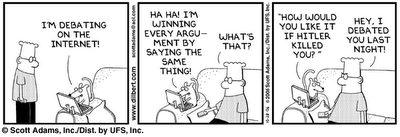
Just as I have been posting about Digg in all their glory, and as I love to talk about how people comment in pretty harsh ways sometimes, this Dilbert cartoon came across me this past week…

Thursday, October 26, 2006
More on Digg
So, part of why fights happen on Digg is because of one user accusing another of “gaming the system.” Peter Abilla explains this all very well. He also links to his previous articles on Digg.
Here is his conclusion:
Economically, this sort of paradigm may make me a communist for my support of Google News.
(A tip of my hat goes to Stephen Dubner for pointing this out.)
Here is his conclusion:
Digg is an economy. Votes represent demand and articles
represent a non-infinite, but exceedingly large supply of articles. Incentives are important in any economy and explain human behavior very well. Incentives can also control behavior that is less desirable, as can be found on sites like Digg and Netscape. The invisible hand on Digg is crippled — the emphasis on being democratic is misguided, since democracies have problems, as is the case with Digg; because of the problems on Digg, hence, Kevin Rose has implemented regulation in the forms of Algorithms and Policies. But, such regulatory measures, in the long run, do not work. What will work, is to use the notion of incentives to curb undesirable behavior. As a consequence, however, here might be fewer votes, but the votes will truly count. Moreover, this might be another revenue model for sites like Digg, which currently rely on an ad-based model.
Economically, this sort of paradigm may make me a communist for my support of Google News.
(A tip of my hat goes to Stephen Dubner for pointing this out.)
Wednesday, October 25, 2006
Speaking of College
In relation to my post yesterday about college education, please read this article by George Will at The Washington Post. Not that it’s a homework assignment, but as usual George Will points out another specific inefficiency in America. This time, Will focuses in on college sports; most notably football and the peculiar fact that they get tax exempt status for a significant portion of their monies even though many of the goals that they state are never really accomplished.
To illustrate his point, George Will writes:
I hope one day to be as excellent a commentator as George Will is, or as excellent an economist as Greg Mankiw, but for now I’ll let them do what they do best. Also, I’d just love to see somewhat try to refute the pose that Will makes in his column. I’m not good enough to do it, plus I agree with him.
To illustrate his point, George Will writes:
How does the NCAA fulfill its proclaimed purpose of maintaining "the athlete as an integral part of the student body"? Only 55 percent of football players and 38 percent of basketball players at Division I-A schools graduate. The New York Times has reported that at Auburn, a perennial football power, many athletes have received "high grades from the same professor for sociology and criminology courses that required no attendance and little work." Eighteen members of the undefeated 2004 team took a combined 97 hours of those courses while at Auburn. Who believes such behavior is confined to Auburn?
I hope one day to be as excellent a commentator as George Will is, or as excellent an economist as Greg Mankiw, but for now I’ll let them do what they do best. Also, I’d just love to see somewhat try to refute the pose that Will makes in his column. I’m not good enough to do it, plus I agree with him.
Tuesday, October 24, 2006
Paying for College
Paul Basken at Bloomberg reports that college tuition is still increasing. While I understand that the yearly increases are obvious fact to anyone, the concerning part comes from the fact that “Pell Grants, the main federal subsidy, fell by an average of $120 per student, or 4.9 percent.”
So, there are two things working against each other right now. On one side, the College Board reported that
However, the increasing cost in tuition puts obvious strain on those pursuing higher education.
In my own personal experience, I have a difficult time addressing these figures from the College Board. Not because I don’t believe them, but for the reason that I (and my single working mother) tried so hard to put me through college. With hard work, we both succeeded (I got my BS Finance degree in four years, and she’s helped 3 of her children through college). I find it unfortunate that those who are willing to work hard for this achievement may be hampered from doing so, whereas another student might be making it through college completely on his parent’s dime.
Now, a real good question to my feelings on the subject is, “If it’s a free market, then why care if the student who doesn’t give a crap -- and is there because his rich guardians are putting him through takes – five years to graduate?” Well, I think that’s where my argument and worries meet their demise. You see, colleges work in different ways than regular businesses do.
That is to say, if you’re paying a lot of money for college, you’re usually paying for a more prestigious education. And if you are getting a more prestigious education, then the school you attend must also have higher standards. So, obviously you can’t fail your way through. The point that I’m trying to make is that in the end, all the people around me who bullied me and drank a whole lot of alcohol deserve to graduate because of four things: either the education and tests were painfully easy (although I can vouch that they were in fact difficult), they had the knowledge to pass the examinations, they picked a less difficult major, or they cheated.
By the way, let me tell you that at my school I remember two people who did specifically cheat. Unfortunately I can’t out them here because I don’t remember there names due to the fact that I didn’t associate myself with them. Although other than the cheating, they seemed rather harmless. Well, harmless except for the fact that their cheating may have negative consequences on the value of the degree that I and my classmates earned.
So, let’s get back on track. Question: Is the market for college strong enough in the right way to correct itself? That is to say, will the middle class and low income prospects gain more strength to go to college? Or, will colleges simply price their education so that only those with a significant sum of money can go? Right now, there’s a bit of a nice medium because the highest level of education (e.g. Harvard) also has the premium that it deserves. Nevertheless, the College Board looks at more colleges than just Harvard, and it seems that colleges that right now seem attainable in attending, may be impossible to afford in the future even if they’re education quality doesn’t change.
So, there are two things working against each other right now. On one side, the College Board reported that
The data reported in Education Pays 2006 document increases over time in the earnings gap between high school graduates and college graduates. In 2005, women ages 25-34 with bachelor's degrees earned 70 percent more than those with high school diplomas, and for men the difference was 63 percent. For all full-time workers in this age group, the average earnings premium for a four-year college degree is almost $14,000.
However, the increasing cost in tuition puts obvious strain on those pursuing higher education.
In my own personal experience, I have a difficult time addressing these figures from the College Board. Not because I don’t believe them, but for the reason that I (and my single working mother) tried so hard to put me through college. With hard work, we both succeeded (I got my BS Finance degree in four years, and she’s helped 3 of her children through college). I find it unfortunate that those who are willing to work hard for this achievement may be hampered from doing so, whereas another student might be making it through college completely on his parent’s dime.
Now, a real good question to my feelings on the subject is, “If it’s a free market, then why care if the student who doesn’t give a crap -- and is there because his rich guardians are putting him through takes – five years to graduate?” Well, I think that’s where my argument and worries meet their demise. You see, colleges work in different ways than regular businesses do.
That is to say, if you’re paying a lot of money for college, you’re usually paying for a more prestigious education. And if you are getting a more prestigious education, then the school you attend must also have higher standards. So, obviously you can’t fail your way through. The point that I’m trying to make is that in the end, all the people around me who bullied me and drank a whole lot of alcohol deserve to graduate because of four things: either the education and tests were painfully easy (although I can vouch that they were in fact difficult), they had the knowledge to pass the examinations, they picked a less difficult major, or they cheated.
By the way, let me tell you that at my school I remember two people who did specifically cheat. Unfortunately I can’t out them here because I don’t remember there names due to the fact that I didn’t associate myself with them. Although other than the cheating, they seemed rather harmless. Well, harmless except for the fact that their cheating may have negative consequences on the value of the degree that I and my classmates earned.
So, let’s get back on track. Question: Is the market for college strong enough in the right way to correct itself? That is to say, will the middle class and low income prospects gain more strength to go to college? Or, will colleges simply price their education so that only those with a significant sum of money can go? Right now, there’s a bit of a nice medium because the highest level of education (e.g. Harvard) also has the premium that it deserves. Nevertheless, the College Board looks at more colleges than just Harvard, and it seems that colleges that right now seem attainable in attending, may be impossible to afford in the future even if they’re education quality doesn’t change.
Monday, October 23, 2006
Lost iPod
Is this your iPod? David Berlind is doing something cool on his blog, and I’m using my blog (and the two people who read it) to help out.
If this isn't a test for how the blogosphere can get things done, I'm not sure what is. As a part of this test, if you happen to read this blog entry and you have a blog, please spread the word and let's see if the viral nature of the blogosphere can help this iPod find its owner.
If any of this means something to you and you've recently lost your iPod, contact me at david.berlind@cnet.com. The photos on this device clearly have some sentimental value. So, it would be great if we (the blogosphere) can help it find its way home. Of course, you'll need to prove to me that it's yours which shouldn't be too difficult.
Friday, October 20, 2006
The Pigou Club
I’m not sure if Greg Mankiw has made Robert Samuelson a member of the Pigou club (a club that calls for taxes on gas and other carbons to correct for all the negative externalities that these fuels cause), but I think Samuelson’s latest article allows him proper distinction to be in the club.
I’d like to think of myself in the club, but I highly doubt that “Yes, I agree” warrants enough qualification to be part of Mankiw’s list. Although, I would like to imagine that if they all got together, they’d let me in the party. The only problem is that for everyone in the group to get together, we’d use a lot of fuel.
I’d like to think of myself in the club, but I highly doubt that “Yes, I agree” warrants enough qualification to be part of Mankiw’s list. Although, I would like to imagine that if they all got together, they’d let me in the party. The only problem is that for everyone in the group to get together, we’d use a lot of fuel.
Wednesday, October 18, 2006
No More Tag
There are too many ways to make fun of this and comment on it, but I’ll try anyway.
First, I wonder how politicians will see this. On the one hand, they’ve been more than happy to take away certain liberties of ours for our own safety. So, I could try and say that they’d be happy in proclaiming that they’ve just made our kids safer.
But on the other hand, if you’re a glorified pundit who is homophobic, this could be a minor blow to you, or not. I mean, on one side the lack of tag and touch football might make our kids serious pansies. On the other side, as a homophobic pundit, you’d probably want to make sure that boys touch boys as little as is humanly possible (which could then be a great reason that baseball is our national pastime). In that case, getting rid of tag to that pundit would be a literal Godsend.
Also, from my memory of recess, if there wasn’t tag, there wasn’t much else to play. So, now our kids might start getting fatter. I know that might be a stretch what with playing with friends after-school and other activities, but for me – as a child – if it wasn’t for school I wouldn’t have had the exercise and activities that made school fun and kept me active physically. Also, in my experience, gym class didn’t come into effect until 6th grade.
As a kid, tag was awesome because I could only get so much soccer, and I wasn’t all that great at tennis yet. Tag filled in a great void of the need for running around for a purpose. Therefore, naturally, I would have distraught if I would not have been allowed to play tag.
How about you? Matt, did you ever play tag? I know you want to comment.
First, I wonder how politicians will see this. On the one hand, they’ve been more than happy to take away certain liberties of ours for our own safety. So, I could try and say that they’d be happy in proclaiming that they’ve just made our kids safer.
But on the other hand, if you’re a glorified pundit who is homophobic, this could be a minor blow to you, or not. I mean, on one side the lack of tag and touch football might make our kids serious pansies. On the other side, as a homophobic pundit, you’d probably want to make sure that boys touch boys as little as is humanly possible (which could then be a great reason that baseball is our national pastime). In that case, getting rid of tag to that pundit would be a literal Godsend.
Also, from my memory of recess, if there wasn’t tag, there wasn’t much else to play. So, now our kids might start getting fatter. I know that might be a stretch what with playing with friends after-school and other activities, but for me – as a child – if it wasn’t for school I wouldn’t have had the exercise and activities that made school fun and kept me active physically. Also, in my experience, gym class didn’t come into effect until 6th grade.
As a kid, tag was awesome because I could only get so much soccer, and I wasn’t all that great at tennis yet. Tag filled in a great void of the need for running around for a purpose. Therefore, naturally, I would have distraught if I would not have been allowed to play tag.
How about you? Matt, did you ever play tag? I know you want to comment.
Tuesday, October 17, 2006
Even Better
In case anyone thought that people had given up on improving Wikipedia…don’t fear. According to CNET, co-founder Larry Sanger is coming out with a rival site called, Citizendium. Sanger said, said. "There are a number of problems with the system that can be solved, and by solving those we can end up with an even better massive encyclopedia."
Well, if it’s going to be even better, I can’t wait. Although, I can only imagine the kind of incentive someone would have trying to change an article (it will be much harder apparently in Citizendium) so that it can portray the truth that they wish it to.
Well, if it’s going to be even better, I can’t wait. Although, I can only imagine the kind of incentive someone would have trying to change an article (it will be much harder apparently in Citizendium) so that it can portray the truth that they wish it to.
Thursday, October 12, 2006
Did They?
I was just “wowed” last night watching a commercial. Now, if I have you wondering what cool commercial this was, I need to tell you that the commercial was not that cool. It was for the 2006 Mercury Milan; a car that itself I’m not sure is even all that “wow” worthy.
However, the song that they used for the commercial was from the band, Morningwood. The song in particular was “The Nth Degree.” Now, thankfully, they used the right part of the song and edited the right parts because otherwise the commercial would allowed for the song to continue to spell out (if you haven’t listened to the song, to literally spell out) “M-O-R-N-I-N-G-W-O-O-D.”
Now, mind you, I personally love the song, and I really dig the band since I saw them open for Kasabian and The Music a year go. I also don’t mind the song being used in the commercial. Even if they let all the wrong words flow, I’d still be okay with it, but they’d probably have to give the commercial a PG rating, but it could still be shown with Girls Gone Wild commercials. Nevertheless, I still can’t believe they actually used the song. Now, whenever I see a Mercury Milan, I’m going to think about Morningwood, and I can’t guarantee that it will always be about the band of same name.
However, the song that they used for the commercial was from the band, Morningwood. The song in particular was “The Nth Degree.” Now, thankfully, they used the right part of the song and edited the right parts because otherwise the commercial would allowed for the song to continue to spell out (if you haven’t listened to the song, to literally spell out) “M-O-R-N-I-N-G-W-O-O-D.”
Now, mind you, I personally love the song, and I really dig the band since I saw them open for Kasabian and The Music a year go. I also don’t mind the song being used in the commercial. Even if they let all the wrong words flow, I’d still be okay with it, but they’d probably have to give the commercial a PG rating, but it could still be shown with Girls Gone Wild commercials. Nevertheless, I still can’t believe they actually used the song. Now, whenever I see a Mercury Milan, I’m going to think about Morningwood, and I can’t guarantee that it will always be about the band of same name.
Subscribe to:
Posts (Atom)

